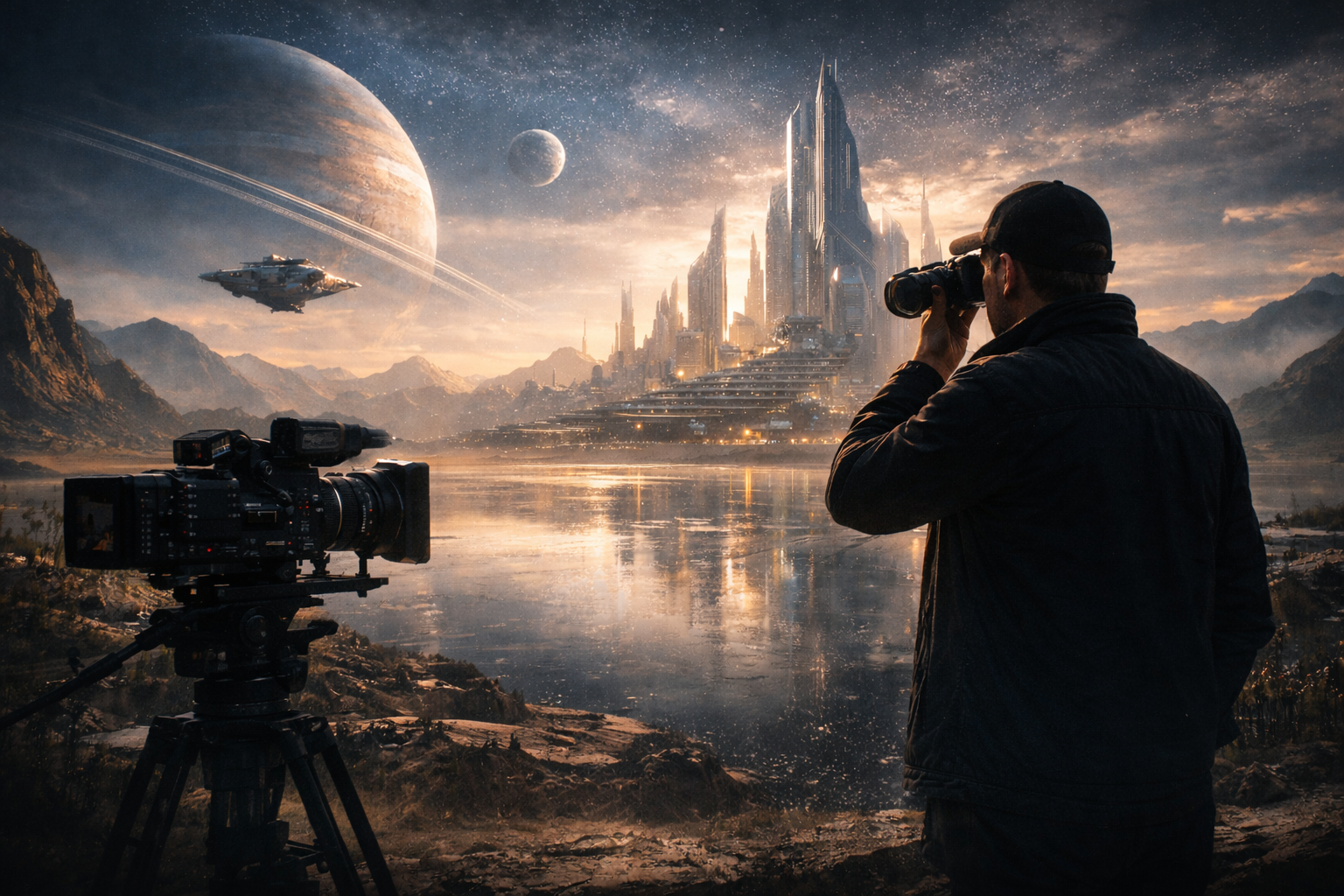
Synthetic Reality is creating a new kind of creative professional.
As film production moves into fully AI-generated environments and avatars, a new role is emerging at the center of this shift: the SR Designer.
This is not a rebranded prompt engineer.
It is not a VFX technician with better tools.
It is not a traditional director using new software.
It is a hybrid discipline that blends storytelling, visual design, systems thinking, and production orchestration into a single role.
And it is quickly becoming one of the most important creative positions in Synthetic Reality production.
Beyond Prompting
An SR Designer is not a prompt engineer.
They are a narrative architect operating inside generative systems.
Prompting is a small surface layer of the work. The deeper craft lies in understanding how multiple AI models behave, how outputs vary across systems, how visual continuity can break between scenes, and how iteration affects pacing and coherence.
Synthetic Reality production requires orchestration across tools such as SeedDance, Kling, Veo, Nano Banana, and others. Each model has strengths, limitations, and stylistic tendencies. The SR Designer must know when to switch, when to refine, and when to rebuild.
This is not randomness. It is control.
The Expanded Skill Stack
SR Designers operate at the intersection of creative and technical fluency.
They must understand:
- Story structure and emotional arc
- Shot composition and cinematic language
- Lighting logic inside synthetic environments
- Avatar identity systems and character continuity
- Voice cloning and lip syncing workflows
- Multi-scene consistency management
- Token optimization and iteration strategy
- Likeness and IP compliance
When everything can be generated, consistency becomes the hardest problem to solve. A character’s face must remain stable across scenes. A world’s lighting must maintain internal logic. Emotional tone must align from shot to shot.
SR Designers manage these variables simultaneously.
A Hybrid Creative Executive Function
In traditional production, responsibilities are distributed. A director shapes performance. A production designer shapes environments. A VFX supervisor oversees digital elements. An editor shapes pacing. A cinematographer defines visual language.
In Synthetic Reality, many of those responsibilities converge.
The SR Designer sits at the center of this convergence. They integrate narrative intention with generative output. They ensure that world-building, character design, and editorial pacing remain cohesive inside a fully synthetic stack.
This role does not eliminate traditional craft. It absorbs and reconfigures it.
The Misconception of “AI Slop”
One of the biggest misconceptions about Synthetic Reality is that it produces low-effort content.
High-quality SR work demands a tremendous eye for detail, disciplined taste, and strong storytelling instincts. It requires someone who understands not just what looks impressive, but what serves the narrative.
When visual scale becomes easy, narrative clarity becomes rare.
The SR Designer is responsible for protecting that clarity.
Scarcity and Value
As Synthetic Reality production scales, the number of tools will increase. Access to generative models will expand.
What will remain scarce is the ability to direct those systems with intention.
The SR Designer is not a temporary role created by a technological wave. It is a new creative profession shaped by it. The demand for professionals who can combine narrative intelligence with generative orchestration will grow as more brands, studios, and production houses adopt fully synthetic workflows.
The role sits at the edge of film, technology, and design.
Where This Is Already Happening
Studios building inside Synthetic Reality are already structuring teams around SR Designers as central operators in the production pipeline. As more organizations adopt fully AI-generated environments and avatar-based storytelling, this role will become foundational rather than experimental.
Synthetic Reality is not simply changing how films are made.
It is changing who makes them.
And at the center of that shift is the SR Designer. 🎬
 Nolie MacDonald
%20Designer.png)
 Nolie MacDonald : Feb 28, 2026 6:07:10 PM
.png)