The pipeline didn’t just get faster. It became cyclical.
In traditional filmmaking, there is a moment where the dream gets expensive.
It happens somewhere between the script and the shoot, when the story stops being language and becomes logistics. Suddenly the idea needs permits, schedules, casting calls, weather, sets, wardrobes, lighting setups, crew availability, and a thousand moving parts that can derail the whole process with one missed connection.
This is why film production has never been purely creative.
It’s always been creative inside a maze.
AI film production tools don’t remove the maze entirely, but they do something just as disruptive: they introduce an entirely new path. A path where the story can be tested, visualized, refined, and reshaped before a traditional production machine ever turns on.
And once that path exists, film stops being only a linear process.
It becomes a loop.
A loop where creators generate, evaluate, refine, and repeat, compressing what used to take months into a series of fast creative cycles that look less like filmmaking and more like software development.
That shift is the real headline.
Because when production becomes iterative, the question isn’t simply “How fast can we create?”
It becomes:
What kinds of stories can we tell when we’re no longer punished for experimenting?
The Linear Era: Why Film Was Built for Scarcity
Traditional film pipelines are engineered around scarcity.
Scarcity of time on set. Scarcity of locations. Scarcity of reshoots. Scarcity of budget for experimentation. Scarcity of tolerance for uncertainty.
Everything in the workflow reflects the assumption that mistakes are expensive. That improvisation is a threat. That changing direction after committing to production is a financial wound.
That’s why linear production requires certainty.
You plan because exploring is costly.
You lock because changing triggers delay.
You approve because production is too expensive to fail publicly.
Even creative teams become conservative under these conditions, not because they lack bold ideas, but because the pipeline is designed to protect itself from chaos.
AI shifts scarcity.
Not by making creativity effortless, but by making early exploration dramatically cheaper. Once exploration becomes affordable, linear production begins to look outdated for certain types of content, especially in a world that moves at the speed of culture.
The Loop Era: How the Workflow Changes
A linear workflow typically moves like this:
Write → Plan → Shoot → Edit → Finish → Release
An AI-driven workflow behaves differently. It cycles:
Concept → Generate → Evaluate → Refine → Repeat
That difference may look small on paper. In practice, it changes the psychology of creating. Instead of treating the shoot as a make-or-break moment, the creator treats the process as a progressive build.
It becomes closer to sculpting than constructing.
In a loop-based system, you don’t need to “get it right” before you begin. You start rough, you test quickly, and you evolve the work through iterative refinement.
And the ability to iterate changes everything.
It changes storytelling because creators can explore multiple tones, aesthetics, and narrative choices without spending months committing to a single direction. It changes production because decisions become informed by quick prototypes rather than imagination alone.
Most importantly, it changes who has access to cinematic storytelling.
Because once iteration becomes cheap, production becomes less exclusive.
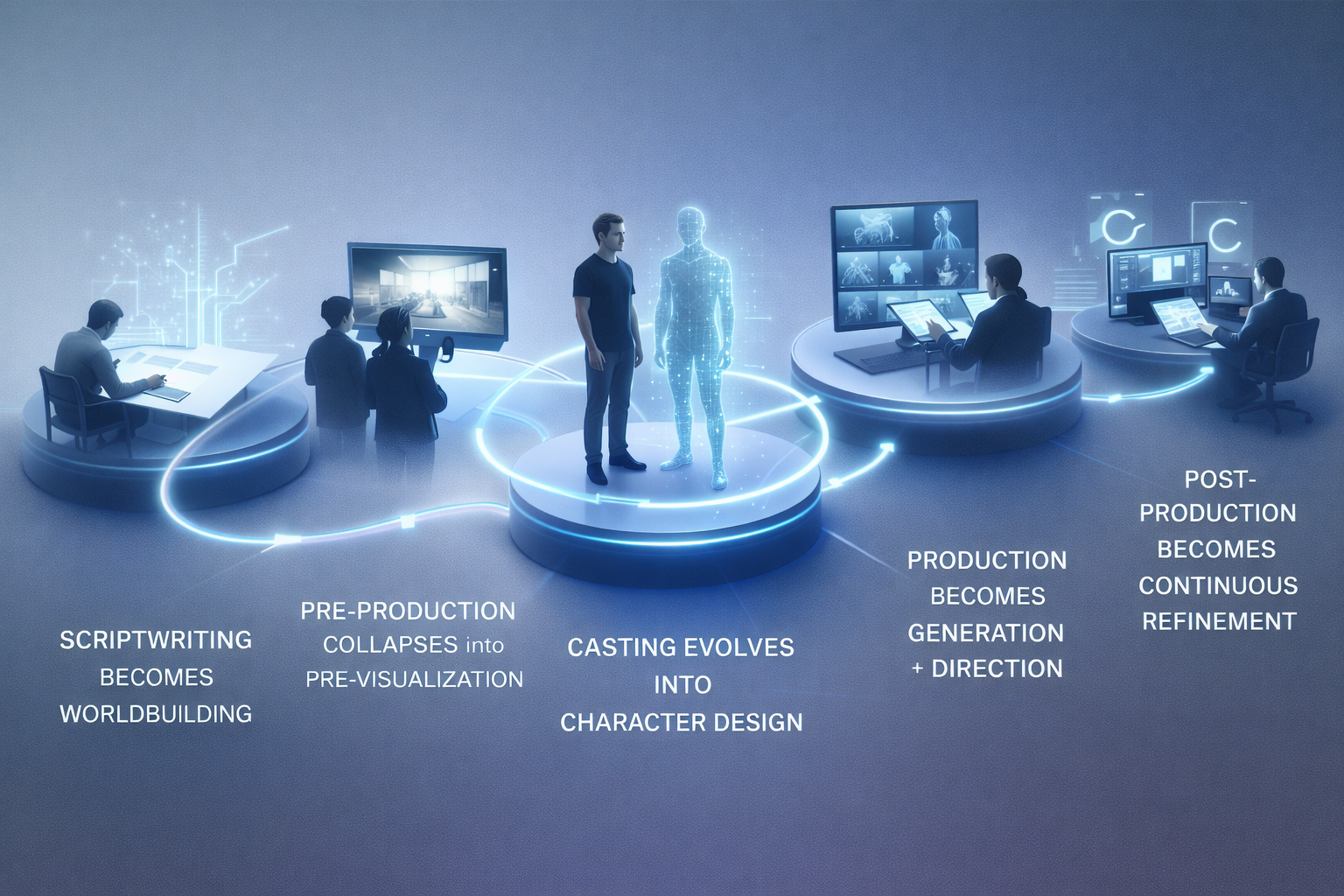
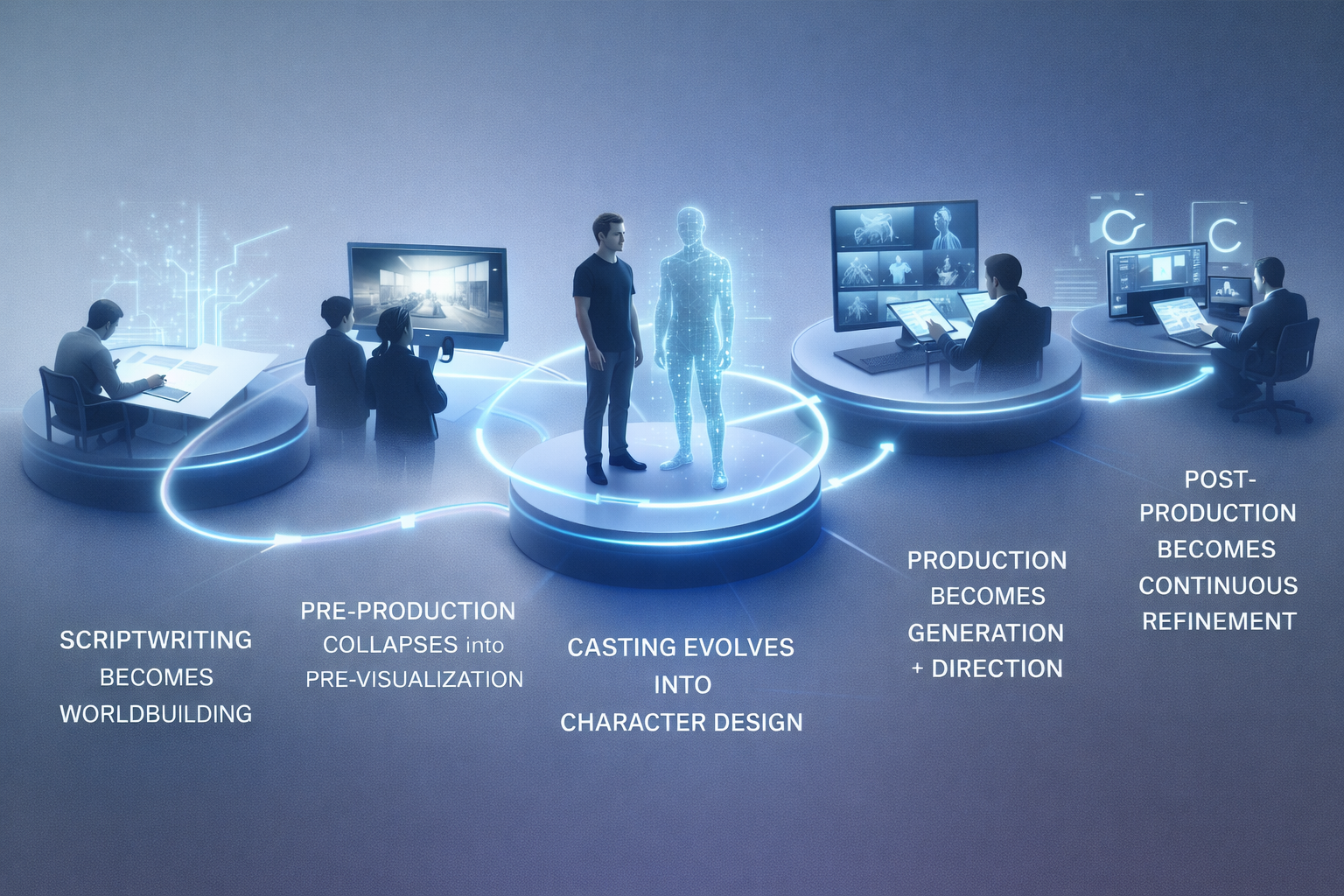
Step One: Scriptwriting Becomes Worldbuilding
In the linear era, scripts are written as commitments. They describe exactly what will happen because every deviation can become expensive later.
In iteration workflows, scripts become more like creative blueprints.
Writers start thinking in branches, in alternate scenes, in optional dialogue, in story variations for different audiences. Instead of producing one version of a story, creators can explore multiple versions of the same moment.
This pushes storytelling toward worldbuilding.
Artists begin building universes rather than single music videos. Brands begin exploring story ecosystems rather than single campaigns. Character identities become central, because once you can generate quickly, the world becomes a playground.
The shift is subtle: the script stops being a fixed plan and becomes a creative space.
Step Two: Pre-Production Collapses Into Pre-Visualization
Traditional pre-production is heavy. Storyboarding, scouting, casting, wardrobe, set design, shot lists, rehearsals. It is the long runway before the plane lifts off.
AI workflows replace much of that with one pivotal practice: pre-visualization.
Instead of imagining how a scene might look, creators can generate draft scenes early and see the world immediately. They can test lighting. Test tone. Test character presence. Test whether a scene emotionally lands.
Pre-vis used to be a luxury reserved for big budgets.
Now it becomes a default strategy.
And this is where the time savings become dramatic. When teams can see the creative reality earlier, fewer expensive surprises appear later. Vision gets clearer faster, and time stops being wasted on ideas that don’t translate visually.
The loop becomes an accelerant for clarity.
Step Three: Casting Evolves Into Character Design
In traditional production, casting is about selecting a human performer.
In avatar-driven workflows, casting expands into something more complex: character design.
Creators are deciding not only who a character is, but what identity will persist across scenes, platforms, campaigns, and even years. They are tuning visual traits, posture, voice, emotional range, and consistency under different lighting and moods.
This creates an entirely new creative asset: an identity that can be continuously used and refined.
For artists, this means digital personas can evolve over time without losing coherence. For brands, it means the “face” of a story can persist beyond a single campaign, becoming recognizable and emotionally sticky.
It’s no longer just “who plays the role.”
It becomes “what identity does the story need to carry.”
Step Four: Production Becomes Generation + Direction
This is where the narrative gets misunderstood.
People hear “AI production” and assume it means automation. That it removes effort.
It doesn’t. It moves the effort.
Instead of spending energy on logistics, creators spend energy on direction. They become curators of performance, mood, and aesthetic. They make hundreds of micro-decisions that shape the work through iteration.
The director’s role becomes less about managing a set and more about managing an evolving system:
Does the scene feel emotionally true?
Does the performance carry intention?
Does the pacing feel cinematic?
Does the character’s identity remain coherent?
Does the world feel like it belongs?
This is why AI production doesn’t reduce creative labor. It increases the number of creative opportunities.
It turns filmmaking into something closer to refining a living sculpture.
Step Five: Post-Production Becomes Continuous Refinement
In linear workflows, post-production is the final stage.
In loop workflows, post-production becomes part of the cycle.
Scenes can be regenerated. Dialogue can be revised. New versions can be created for different formats, languages, or audiences. Content can evolve after it launches, which reframes production entirely.
Instead of releases being “final,” they become starting points.
This is where the most interesting future emerges: content that adapts. Storytelling that stays alive. Brands and artists building cinematic identities that can evolve as culture evolves.
The film becomes less like a finished object and more like a living system.
The Hidden Shift: Taste Becomes the Real Competitive Edge
When anyone can generate content quickly, the advantage is no longer access to tools.
The advantage becomes taste.
Taste is what determines whether something feels meaningful or hollow. Whether an avatar feels human or empty. Whether a story becomes culture or becomes noise.
As the pipeline collapses into loops, the world will flood with content. The creators who win will not be the ones who generate the most.
They’ll be the ones who build worlds people want to stay in.
A Thought to Leave You With
The most disruptive part of AI film production isn’t that it makes things faster.
It’s that it makes experimentation survivable.
Linear filmmaking trained creators to avoid risk.
Iteration loops reward risk because the cost of exploring is lower.
And when exploring becomes accessible, storytelling becomes bolder.
The question isn’t whether film production will change.
It’s whether we’ll use this shift to make more meaningful art, more honest stories, and more emotionally resonant worlds…
or whether we’ll flood the world with content that looks cinematic but feels empty.
 Nolie MacDonald

 Nolie MacDonald : Jan 4, 2026, 8:31:46 AM

 Nerdle
%20Designer.png)