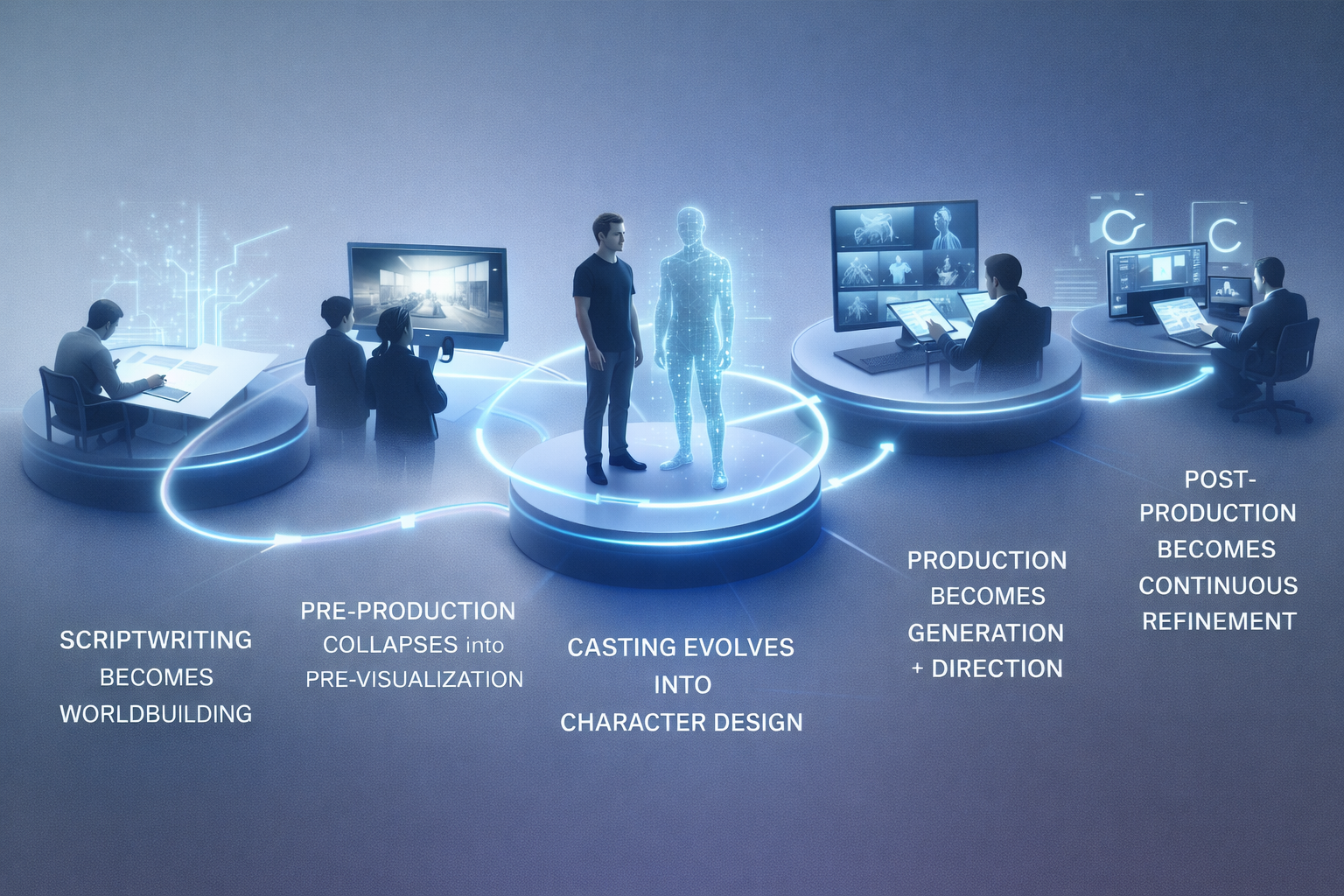
For over a century, filmmaking has depended on the physical world.
Sets had to be built. Locations had to be secured. Actors had to be on-site. Cameras captured matter interacting with light and time, and entire industries formed around making that reality controllable.
Synthetic Reality (SR) breaks that dependency.
SR represents 100% AI-generated environments used in film production, paired with avatars and synthetic performers operating inside those environments. This is a full production stack built on generative systems, where the world, the characters, and the final footage can be created through AI video generation pipelines.
What Synthetic Reality (SR) Includes
At its core, SR is made of fully synthetic building blocks:
 AI-generated environments that can produce cinematic worlds on demand, with controllable atmosphere, geography, architecture, lighting, and continuity.
Avatars and digital performers that can be entirely original characters or created from a real actor’s likeness, when permission is granted to use their IP.
AI video generation workflows where scenes are produced, refined, and re-produced through advanced models, then assembled into final episodic or feature content.
This is not “digital scenery.” This is a fully synthetic film space.
The Likeness Economy Is Emerging Fast
The concept of licensing IP is familiar. Gaming has done it for decades, especially sports titles that represent athletes through likeness rights.
What’s rapidly emerging now is the use of a licensed likeness inside cinematic SR productions.
With permission and contractual agreement, a performer’s likeness can be deployed as a film-ready digital presence, enabling work that is unconstrained by physical production realities. This introduces an entirely new production capability: talent-as-IP operating at the speed of compute.
It also introduces a new business layer for entertainment: negotiating, managing, and protecting likeness rights as a core ingredient of content creation.
The SR Cost Structure Changes the Game
Traditional 60-minute television episodes often live in a world of high fixed costs: physical production, travel, scheduling, crews, equipment, reshoots, and long post pipelines.
In SR, the economic model is fundamentally different.
A 60-minute episode produced in a fully SR pipeline can land in the range of $30,000 to $60,000, factoring in the realities of iteration, including:
- Multiple retakes that consume tokens for AI video generation output
- High-touch refinement to maintain continuity and cinematic quality
- Specialized SR Designers who understand how to orchestrate across models such as SeedDance, Kling, Veo, Nano Banana, and others
Instead of paying primarily for physical logistics, productions pay for compute, iteration, and expertise.
And when the cost of production collapses, volume and experimentation expand.
SR Designers Become the New Production Backbone
SR isn’t “press a button, get a show.”
It demands creators who know how to reliably shape generative outputs into coherent cinematic reality. SR Designers sit at the intersection of production designer, VFX supervisor, AI operator, and continuity director.
They manage:
- Visual consistency across scenes and episodes
- Character continuity for avatars and likeness-based performers
- Prompt architecture and model control
- Iteration strategy (retakes without blowing out token budgets)
- Aesthetic cohesion across different model outputs
In SR, the designer’s craft is controlling the infinite.
What Happens to Traditional Infrastructure
When environments and performers are fully synthetic, the physical production ecosystem no longer holds the same gravity.
Backlots, builds, permits, travel logistics, and weather constraints stop being default requirements. The economic center shifts toward:
- Generative pipelines
- Likeness/IP strategy
- Story development
- Compute and model expertise
- Creative direction with fast iteration
This is a broad redistribution of where money, time, and leverage sit inside production.
Why Storytelling Becomes the Real Advantage
SR makes cinematic scale easier to produce.
When scale becomes easier, scale becomes less differentiating.
As synthetic worlds become abundant, what remains scarce is the ability to create meaning inside them. The projects that win are the ones that make audiences feel something, remember something, and come back for more.
In SR, storytelling becomes the primary competitive edge.
The Career Opportunity for Copywriters and Natural Storytellers
This is where copywriters and narrative minds step into a bigger arena.
The skills that set content apart in the SR era are not about having access to a location or a production budget. They’re about:
- Character voice that feels alive
- Emotional arcs that hold attention for 60 minutes
- Dialogue that creates attachment
- Story structure that earns binge behavior
- Worldbuilding that feels intentional rather than generated
SR unlocks new career pathways for storytellers because the production system now depends on narrative clarity to guide generative output.
Roles that emerge or grow in importance include:
SR Narrative Director
Story leadership that aligns every generated scene with emotional intention and episodic structure.
Avatar Character Architect
Designing identity, voice, and continuity for synthetic performers across an entire series.
Generative Scene Strategist
Translating narrative beats into repeatable generation workflows that preserve coherence across retakes.
Likeness-IP Story Consultant
Writing and structuring projects around licensed talent, ensuring the character use is compelling, consistent, and valuable.
Serialized IP Builder
With production costs dramatically lower, writers can build and test new universes faster, turning storytelling into an engine for scalable IP.
In SR, story is not the garnish.
It is the operating system.
The Shift SR Makes Inevitable
Synthetic Reality ends filmmaking as we know it because it removes the physical constraints that shaped the industry’s economics, timelines, and gatekeeping.
The new landscape is defined by:
- Fully AI-generated environments
- Avatars and likeness-based performers (with permission and IP control)
- Iteration-driven production measured in tokens and retakes
- Lower episode costs that expand creative throughput
- A sharper premium on storytelling as the true differentiator
In the SR era, the most valuable creators are the ones who can take infinite visual possibility and turn it into something audiences can’t stop watching. 🎬
 Nolie MacDonald
.png)
%20Designer.png)
 Nolie MacDonald : Feb 27, 2026 4:34:22 PM